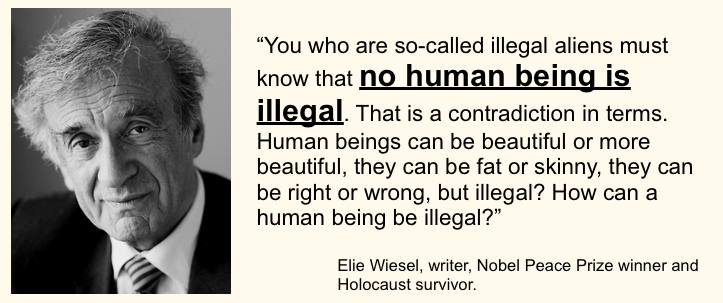
A Concern About Pam Bucy’s Record on Immigration Issues

Pam Bucy is one of two Democratic candidates for Attorney General of the State of Montana.  Last week, we reviewed the voting record of her opponent in the primary election, Jesse Laslovich, regarding state-level enforcement of federal immigration laws.  Unlike Jesse Laslovich, who had served in the Montana Legislature for ten years, Pam Bucy has not previously served in an elected position.  Therefore, she has no voting record on immigration issues that we can analyze.

At the a debate last week moderated by Marnee Banks of KXLH, I submitted a question of the candidates:  ”What do you believe is the proper role of the state law enforcement in dealing with federal immigration laws?”  (The question does not appear to have been included in the video that was posted online.)  Pam Bucy stated very clearly that the Montana Highway Patrol has no role whatsoever in enforcing federal immigration laws.  Presently, there are no laws permitting the Montana Highway Patrol or any other state or local law enforcement officers to enforce federal immigration laws, but it is still happening on a routine basis.  I have had occasion to review many instances in which law enforcement officers have asked individuals about their immigration status and held them without legal cause while they call Immigration and Customs Enforcement (“ICE”) or check federal databases to determine their immigration status.  Naturally, this practices often results in racial profiling.  I took Pam Bucy’s comments to be a strong rejection of that precedent.

Nevertheless, without a voting record to rely upon, it becomes more important to consider any other information that may reflect upon the relevant issues.  To that end, I will recount a professional interaction with Pam Bucy that may shed light on her interpretation of the Montana Constitution, the privacy protections provided under state law, and the role of the state in sharing information with the federal government.  As discussed below, I believe this interaction with Pam Bucy raises some concerns.

In the course of a federal lawsuit I was defending, I came across documents revealing that the State of Montana Unemployment Insurance Division had been illegally disclosing confidential personal information for years.  Almost every businesses in Montana must file Quarterly Wage Reports with the State, containing employees’ names, social security numbers, and salary information.  From at least 2005 to 2007 — and likely continuing long after these dates — officers with Immigration and Customs Enforcement (“ICE”) would contact the Unemployment Insurance Division and ask for copies of the Quarterly Wage Reports for businesses that were “under investigation.”  ICE is an agency within the Department of Homeland Security, and is charged with enforcing federal immigration laws.

The Unemployment Insurance Division routinely violated Montana’s Constitution and statutes by providing non-redacted copies of all of the requested Unemployment Insurance reports, without any warrant or legal basis for doing so.  In other words, they would disclose confidential information on every single employee, including their names, social security numbers, and wages, without demanding a warrant or even limiting the disclosure to specific individuals who were allegedly under investigation.

This allowed ICE to engage in a “fishing expedition” and secretly investigate every employee of a business, without any individual suspicion about each particular employee’s immigration status.  ICE agents could use the names and social security numbers they received from the Unemployment Insurance Division to attempt to ascertain the immigration status of every single employee.  ICE agents used a flawed database to crosscheck their social security numbers, and in some cases they incorrectly transcribed employees’ information.  Therefore, some authorized workers who had done nothing wrong were falsely believed to have invalid social security numbers, and were improperly detained while this was sorted out.

On June 28, 2010, I brought this information to the attention of Pam Bucy, then serving as Chief Legal Counsel for the Montana Department of Labor and Industry.  As I stated in my letter:

The warrantless disclosure of the names, social security numbers, and salaries contained in these Unemployment Insurance Reports is strictly prohibited under Montana’s Constitution and statutes.  The Montana Constitution includes a fundamental “Right to Privacy” provision, which provides that:  “The right of individual privacy is essential to the well-being of a free society and shall not be infringed without the showing of a compelling state interest.”  Mont. Const., Art. II, § 10.  In addition, the Montana legislature has made its intent clear that the names, social security numbers, and salary information contained in the state’s mandatory Unemployment Insurance reports shall be kept private and confidential.

The relevant statute provides:

“Information obtained from any individual under this chapter must, except to the individual claimant to the extent necessary for the proper presentation of a claim, be held confidential and may not be published or be open to public inspection, except to public employees in the performance of their public duties, in any manner revealing the individual’s or employing unit’s identity, but any claimant or the claimant’s legal representative at a hearing before the board or appeal tribunal must be supplied with information from the records to the extent necessary for the proper presentation of the claim.”   MONT. CODE ANN. § 39-51-603(3).

Therefore, by statute, the confidential information held by the Unemployment Insurance Division may only be disclosed under two circumstances:  (1) if a claimant or representative requires such information in order to make a claim for unemployment insurance, or (2) if a “public employee” must inspect the information in the performance of “public duties.”  Regardless of what the Unemployment Insurance Division believed when transmitting Unemployment Insurance reports to ICE, employees of the federal government are not “public employees” as contemplated by statute.

The term “public employee” refers to employees of the State of Montana, not employees of the federal government.  The relevant statute provides:

“’Public employee’ means:  (a) any temporary or permanent employee of the state;  (b) any temporary or permanent employee of a local government;  (c) a member of a quasi-judicial board or commission or of a board, commission, or committee with rulemaking authority; and  (d) a person under contract to the state.”  MONT. CODE ANN. § 2-2-102(7).

Federal employees are not incorporated into this definition and are not “public employees” under Montana law.  Therefore, it is clear that the Unemployment Insurance Division could not legally transmit Unemployment Insurance reports to ICE without a warrant.  The federal government obtained no such warrant.  The complete and un-redacted reports were simply offered in response to written correspondence.

It is especially troubling that the Unemployment Insurance Division released un-redacted copies of these Unemployment Insurance reports without limiting the scope of its disclosure to any specific individuals who were under investigation.  The Montana Supreme Court has held that all individuals retain a privacy interest in personal information such as their social security numbers.  Jefferson County v. Mont. Std., 318 Mont. 173, 180 (Mont. 2003) (even a public official involved in criminal activity, and therefore triggering the public’s right to know in ways not at issue in this case, “does retain a privacy interest in other types of personal information not relevant to her status as a public official, such as her social security number and driver’s license number”); see also Havre Daily News, LLC v. City of Havre, 333 Mont. 331, 341 (Mont. 2006) (acknowledging “that an individual has a protected privacy interest in her social security number and driver’s license number”).

Under Montana law, “[f]ew things are more inherently private” than an individual’s social security number.  State v. Jones, No. DC 03-12, 2003 Mont. Dist. LEXIS 2304 (Mont. Dist. Ct. Nov. 20, 2003).  Accordingly, under the Montana Constitution, the federal government was required to get a warrant before obtaining any records from the State of Montana that disclosed social security numbers.  By voluntarily disclosing private information without any warrant or legal authority, the Unemployment Insurance Division violated the privacy rights of dozens of employees of Melaque Butte, LLC.

Montana statutes also provide that “personal information” such as social security numbers cannot be disclosed by any state agency. MONT. CODE ANN. § 2-6-501(4)(a); 2-6-502.

I concluded my letter by noting that:

The Unemployment Insurance Division is required by law to implement procedures to prevent precisely this type of privacy violation.  Statute provides that:

In order to prevent the misuse of personal and other sensitive information collected by the department in the administration of the unemployment insurance laws, the department shall adopt rules providing for confidentiality of unemployment insurance information, including the circumstances and conditions under which information may be disclosed to appropriate persons and government agencies.  MONT. CODE ANN. § 39-51-603(4).

The same requirement exists in MONT. CODE ANN. § 2-6-502.  A review of the Administrative Rules of Montana reveals no such rulemaking.

On July 22, 2010, I received a response from Pam Bucy.  She argued that “the Unemployment Insurance (UI) program is a cooperative federal-state effort” and claimed that there is an exception written into federal law that would allow Unemployment Wage Reports to be sent to any agency of the federal government without a warrant.  She stated:

20 C.F.R. § 603.4 is the federal rule that requires protection of confidential UI information.  20 C.F.R. § 603.5 enumerates limited exceptions to the confidentiality requirement. Among them is an exception for public officials in performance of their official duties. “Public official” is defined in 20 C.F.R. § 603.2(d) as “an official, agency, or public entity within the executive branch of Federal, State, or local government who (or which) has responsibility for administering or enforcing a law . . .”  Under the preceding authorities, the Department can transmit information to a federal executive agency for performance of their official duties without a warrant.

Of course, there was an obvious and substantial problem with Pam Bucy’s interpretation of the law.  On September 27, 2010, I responded to Pam Bucy’s incorrect assertions:

While I understand and appreciate the fact that you were not personally involved in the decisions made by the Department of Labor and Industry (“DOLI”) in this case, I believe your justification for their actions are not legally supportable.  Contrary to your assertions, federal laws only trump the privacy protections outlined under Montana law if authorities have a court order or subpoena.  Otherwise, federal laws do not in any way curtail the strict confidentiality provisions of MONT. CODE ANN. § 39-51-603(3).

In your letter, you state that the “public official” exception contained in 20 C.F.R. § 603.5(e) allows DOLI to share confidential unemployment insurance information with federal agencies without a warrant.  However, the exceptions upon which you rely for this argument are not supported by the plain language of the regulations themselves.  The law states in pertinent part as follows:

“Disclosure of confidential UC information is permissible under the exceptions in paragraphs (a) through (g) of this section only if authorized by State law and if such disclosure does not interfere with the efficient administration of the State UC law. Disclosure of confidential UC information is permissible under the exceptions in paragraphs (h) and (i) of this section without such restrictions.”  20 C.F.R. § 603.5.

The “public official” exception you rely upon is in paragraph (f) of this regulation, and is therefore applicable only if the disclosure is authorized by Montana law. You have not cited to any statute or constitutional provision that allows state agencies in Montana to turn confidential unemployment insurance information over to federal agencies without a warrant.

Under the plain language of MONT. CODE ANN. § 39-51-603(3), the confidential information held by the Unemployment Insurance Division may only be disclosed under two circumstances:  (1) if a claimant or representative requires such information in order to make a claim for unemployment insurance, or (2) if a Montana “public official” must inspect the information in the performance of “public duties.”  Nowhere in Montana law does it state that information can be provided to federal “public officials” without a warrant.  In fact, the disclosure of such information is in direct violation of the Montana Constitution itself.

The only exceptions in 20 C.F.R. § 603 that actually trump state law are in paragraphs (h) and (i). The exception in paragraph (h) allows the disclosure of confidential information with a court order or by subpoena.  A court order was neither sought nor obtained in this case.  The exception in paragraph (i) pertains to disclosure for program oversight and audit purposes. Neither of these exceptions applies when a federal agency, such as Immigration and Customs Enforcement (“ICE”), makes a general request for information without a court order or warrant.  Accordingly, I am forced to conclude that you have not provided any authority demonstrating that such a disclosure is legal under state or federal law.

On October 15, 2010, I received another response from Pam Bucy.  In this letter, she noted that she had created new rules to address precisely this situation:

Thank you for your further comments and questions regarding the Department’s policies and procedures on disclosure of personal identifying information. Though I don’t agree with all of your legal conclusions, your argument is certainly noted. First, I wish to assure you and your client that the Department of Labor and Industry is no longer releasing any information to ICE or any other federal or state agencies with which we don’t have information sharing agreements. Though ICE agents have sought information recently, that request has been denied. ICE has been informed that no further information will be provided until the applicable rules have been finalized and that any future release of information will be done pursuant to those rules.

Pam Bucy attached a copy of the new rules, and they were ultimately enacted into law on April 15, 2011.  Initially, I viewed the new rules as protecting release of confidential information without a warrant or valid subpoena.  However, the rules that were enacted contain a very important difference from the version that was provided to me.  As I reviewed the law on the books, I discovered that it contained exceptions so broad that they would effectively destroy any privacy protections that were created.

The new rules provide for three relevant exceptions to confidentiality:

The department shall bar the disclosure of personally identifying information, except as disclosure is permitted by the informed consent of the identified individual(s) or is required under federal or state law to a public official for use in the performance of official duties or pursuant to a valid subpoena or interagency cooperative agreement.

The first problem with the new rule is that it expands the definition of a “public official” to allow for the release of confidential information to federal officers.  Previously, the law stated that only state employees were public officials.  However, the new regulations changed the definition to include:  ”an official, agency, or public entity within the executive branch of federal, state, or local government with responsibility for administering or enforcing the law.”

There is also a critical difference between the version of the law that was enacted and the version that was sent to me.  In statutory interpretation, whole meanings of the law can depend upon single words.  In this case, the change amounts to the deletion of the word “or,” but this minor change could have significant consequences.  The version that was provided to me stated that:

The department shall bar the disclosure of personally identifying information, except as disclosure is . . . required under federal or state law to a public official for use in the performance of official duties pursuant to a valid subpoena or interagency cooperative agreement.

In legalese, this version would have only allowed public officials to obtain information only pursuant to a valid subpoena.  But in the version that was enacted, there is an “or” placed in front of the clause stating “pursuant to a valid subpoena.”  In statutory interpretation, this would allow release of confidential information to a public officer even without a valid subpoena.  This is a critical difference, and one that violates Montana’s Constitution and statutes.  I have confirmed that this is not just a typo on the Administrative Rules of Montana website — it also appears in the print version.  If this is simply an error, then I hope it will be quickly corrected in print and online.

[Update:  I have confirmed that the change is not an error; although the draft rule provided to me required a "public official" to obtain a subpoena, the change was made sometime between October 2010 and February 2012.  The notice of rule making included the omission.  I have done a compare and merge of the two versions, and this was the only substantive change in the two versions.]

The second major problem with the new law is that it would allow the release of confidential information through an “interagency cooperative agreement.”  The new rules do not provide any clarification on the requirements to enter into such an agreement, stating simply:

“[I]nteragency cooperative agreement” means a written data-sharing agreement between the department and a public official.

On October 15, 2010, I wrote seeking clarification about how the Department of Labor and Industry would go about ensuring confidentiality of information released pursuant to an “interagency cooperative agreement.”  I never received any response.

The Montana Constitution and statutes protect the release of confidential Unemployment Insurance information, so it is not clear how or why a simple written agreement can trump these privacy protections.

On January 16, 2012, Pam Bucy informed me in a conversation that Immigration and Customs Enforcement (“ICE”) officers have not entered into an ”interagency cooperative agreement” to obtain confidential Unemployment Insurance information.  However, she also stated that she was somewhat surprised that they never took this step.  To me, this revealed that she never truly intended to prevent the conduct I went to her to address.

I believe that the manner in which Pam Bucy handled this situation calls into question her interpretation of the privacy protections of the Montana Constitution, and her willingness to share confidential information with the federal government.  These are issues that are important to those who oppose state-level enforcement of immigration laws, but are also important to Montana in many other respects.  For instance, this may be of interest to those who are advocating for Montana’s medical marijuana laws.

In summary, I believe that Pam Bucy took conduct that was a very clear violation of the law, wrote new rules to seemingly prohibit the illegal conduct, but also created significant loopholes that would purport to legalize this very same conduct.

In the end, I view this as actually making our confidentiality protections worse — not better.  In the interest of bureaucratic administration, I believe Pam Bucy has set aside important privacy considerations under Montana law.  As Attorney General, Pam Bucy would often be called upon to deal with conflicts between state and federal laws, and I believe that Montanans expect our Attorney General to enforce our laws and privacy protections despite warrantless requests from the federal government.  To the extent that Pam Bucy’s conduct reflects the manner in which she will handle such issues as Attorney General of the State of Montana, I have serious concerns.

I will continue to monitor what ”interagency cooperative agreements” the Unemployment Insurance division enters into to release confidential information to the federal government, and determine if legal action needs to be taken to challenge the administrative rules that Pam Bucy helped create.

If you are an employee or business owner who has concerns about your private information being secretly released to the federal government without a warrant, I encourage you to complain to the Governor’s office.

Jesse Laslovich’s Voting Record on Immigration Bills in the Montana Legislature

Jesse Laslovich is running for Montana Attorney General, and faces a Democratic primary this June.  Jesse Laslovich has served in the Montana legislature since 2000 — first in the Montana State House of Representatives (from 2000-2004) and then in the Montana Senate (from 2004-2010).  The purpose of this post is to analyze his voting record on immigration bills that have come before him.

This research revealed some interesting surprises.

Since 2005, several bills have been sponsored to involve the State of Montana in enforcement of federal immigration laws.  In reviewing a legislator’s voting record on immigration bills, it is important to note that prior to 2007, there were few or no lobbying groups or non-profit entities that were working to lobby or educate on the issue of immigration in Montana.  In 2007, federal immigration reform became a hotly discussed issue, leading to more state-level bills and greater public debate.  At the same time, groups like the Montana Human Rights Network began to lobby on the issue of immigration for the first time.  The record reveals the value that this increased participation has produced.  While major Democratic party leadership voted inconsistently on immigration issues prior to 2007, there was a nearly uniform party stance with regard to these bills in the 2009 and 2011 legislatures — with Democrats opposing state involvement in federal immigration laws, and Republicans in support.

2001 and 2003 Sessions

No relevant immigration-related bills were discovered during the 2001 and 2003 legislative sessions, when Jesse Laslovich served in the House.

2005 Session

This was Jesse Laslovich’s first session in the Senate.  During this session, Jesse Laslovich sponsored SB 149, with the short title:  ”State service contracts to be performed by citizen, legal alien, or visa holder.”  The bill would have amended an existing statute to require that state service contracts include language stating that “only citizens of the United States, legal resident aliens, or individuals with a valid visa will perform the services under the contract or any subcontract under the contract.”

The bill did not use the term “illegal alien” and did not seek to impose and civil or criminal penalties.

The bill included a clause stating that its new terms do not apply ”if the department determines that there is no responsible vendor meeting the requirements,” if “the cost of complying . . . would create an economic hardship for the state” or if it “would not be in the best interests of the state.”

The minutes from the hearing reveal the reasons that Jesse Laslovich brought the bill:

SEN. LASLOVICH stated that he was bringing the bill forward as the result of a request from a constituent. His constituent asked him what he could do to help prevent the outsourcing of jobs from Montana. He went on to say that he had contacted a friend from the Michigan Legislature who informed him about a bill that Michigan had tried to put through, and this bill was modeled after that bill. SEN. LASLOVICH explained that what the bill would do is prevent state agencies from entering into contracts for the purchase of services with persons, companies or agencies not citizens of the United States.  He informed the Committee that the Department of Administration stood in opposition to this bill because of what they felt would be unintended consequences.

Don Judge, who is running for House District 82 and also faces a primary this June, came out in support of the bill.  He spoke on behalf of Teamsters Local 190, saying “that they understood there could be some concerns regarding this legislation, however, his organization stood in support of the bill.”

The bill ultimately passed the Senate and was transmitted to the House, where it was tabled in committee.  This is the only bill that Jesse Laslovich has sponsored in his legislative career that directly dealt with the issue of immigration.

During the same session, HB 304 was sponsored by Diane Rice (R) to prevent a “person commonly known as an illegal alien” from operating a motor vehicle in the state or getting a driver’s license.  This bill passed the House and was transmitted to the Senate.

Montana progressives may be surprised by some of the bill’s supporters, including Robyn Driscoll (D), Kevin Furey (D), Gail Gutsche (D), Carol Juneau (D), Christine Kaufmann (D), and Dave Wanzenried (D).  Mary Caferro (D) was only one of six who voted against the bill on seceond reading.  I was unable to determine if there was some strategy behind the decision to vote for this bill, but on its face this would be viewed as an “incorrect” vote to avoid state involvement in enforcement of federal immigration laws.

The bill passed the House and was transmitted to the Senate, where it was tabled in the Senate Judiciary committee on which Jesse Laslovich served.

When groups like the Montana Human Rights Network began to work on immigration issues in 2007, and were able to lobby and provide greater education on the issues, these prominent Democrats would vote dramatically differently in later sessions.

It should be noted that another law restricting driver’s licenses based on immigration status actually passed that year instead of HB 304. Another bill, HB 385, imposed the language that was in our laws until just recently, restricting a license to any person “who does not submit proof satisfactory to the department that the applicant’s presence in the United States is authorized under federal law.”  This bill passed the House, and also passed the Senate in a 48-0 vote, with Jesse Laslovich joining in the unanimous decision.

2007 Session

In the 2007 session, when Jesse Laslovich was serving as chair of the Senate Judiciary Committee, there were several anti-immigrant bills sponsored by Jim Shockley.  One of them was SB 260, which would make it a felony for an “illegal alien” to register to vote.  This bill died on second reading in the Senate, with Jesse Laslovich voting to kill the bill.

Another bill was SB 389, which would allow state or local police officers to detain and question people about their federal immigration status.  The bill was tabled in the Senate Judiciary Committee, with Jesse Laslovich voting against allowing it to move to second reading.  Therefore, the bill died in standing committee.

Jim Shockley also sponsored SB 258, which would deny state licenses and license renewal to “illegal aliens.”  The bill passed out of the Senate Business, Labor, and Economic Affairs (which Jesse Laslovich was not a member of).  The bill passed second reading, with Jesse Laslovich voting against the bill.  He voted against the bill on third reading as well, but the bill was transmitted to the House.  The House amended the bill and returned it to the Senate, where Jesse Laslovich again voted against it.  The bill finally died in the Senate on a close 25-25 vote.

My research only revealed one bill during the 2007 session in which Jesse Laslovich voted in favor of imposing restrictions or penalties based on federal immigration status.

SB 346 would have “prohibited certain contracts with illegal aliens.”  In its original language, the bill used the offensive and inaccurate term “illegal alien” throughout the text.  However, this term was stricken and amended to read “unauthorized alien,” which is a defined term within the Immigration and Nationality Act.  As amended, the bill would have prohibited the state from entering into a public contract or subcontract with any person who knowingly employs or contracts with an unauthorized alien, prohibited an unauthorized alien from contracting with the state, and provided criminal penalties (as a misdemeanor) for any unauthorized alien who violated the law.

After being amended, the bill passed Executive Action in the Senate Judiciary Committee by a vote of 11 to 1.  Carol Juneau (D) was the sole ‘No’ vote.  The committee members who voted for the bill were Jesse Laslovich; Lynda Moss (D);  Gary Perry (R); Aubyn Curtiss (R); Larry Jent (D); Dan McGee (R); Jerry O’Neil (R); Gerald Pease (D); Jim Shockley (R); Dave Wanzenried (D); and Carol Williams (D).

The bill ultimately passed the Senate 33-17.  Jesse Laslovich voted to pass the bill.  Other notable votes in favor included:  Steve Gallus (D), Kim Gillan (D), and Larry Jent (D).  Notable votes against the bill included:  Joe Balyeat (R), Carol Juneau (D), and Christine Kaufmann (D).  Also notable is the fact that Lynda Moss (D), Dave Wanzenried (D), and Carol Williams (D) changed their votes to ‘No’ after previously voting to pass it out of committee.

SB 346 died in the House, and was not enacted into law.  While there were some other immigration-related bills in the 2007 session, my research did not reveal any others where Jesse Laslovich had occasion to vote on them.

2009 Session

I have written about the 2009 legislative session in some detail on this blog.  This was the first session in which I actively lobbied in support of immigrant rights, and it was also the most contentious session to date on the issue of state immigration enforcement.  There were 11 relevant anti-immigrant bills that were sponsored during this session by David Howard (R), Gary MacLaren (R), Edward Butcher (R), Gary Perry (R), and Jim Shockley (R).  A description and summary of most of the bills can be found here.

Many of these bills originated in the House and were tabled or defeated before being transmitted to the Senate.  Therefore, Jesse Laslovich only had occasion to vote on a few of these bills.  On all but one of the bills that he was presented with, he made a “correct” vote against state-level enforcement of federal immigration laws.

SB 379 would have made it a misdemeanor or felony to transport, move, conceal, harbor, or shield any alien that you know to be undocumented.  It would also have made it a misdemeanor or felony to encourage an undocumented alien to enter or remain in the state without status.  The bill would also have provided for forfeiture of property belonging to anyone convicted of any of those offenses.  Jesse Laslovich voted against the bill at every vote, but it still passed the Senate.  It was transmitted to the House, where it was tabled in committee.

SB 380 would have required the county treasurer’s office to investigate immigration status and deny motor vehicle registration to undocumented immigrants.  The bill would have resulted in less accurate motor vehicle registrations.  Rather than throwing their hands in the air and going home, undocumented immigrants would simply register in other people’s names or not register at all.  Jesse Laslovich’s Senate Judiciary committee tabled the bill.

SB 381 would have required the state to enter into a costly Memorandum of Understanding so that the Highway Patrol could be deputized to act as Immigration and Customs Enforcement (“ICE”) agents and enforce immigration laws.  This was sponsored by Shockley and passed the Senate Judiciary committee.  Jesse Laslovich voted against the bill at every vote, but it still passed and was transmitted to the House.  It was ultimately tabled in the House Judiciary Committee.

SB 382 would have required the state to expend significant time and resources “cooperating with” the federal government in immigration investigations, and would have prohibited any law that would conflict with obligations to “cooperate with” the federal government.  Once again, Jesse Laslovich voted against the bill at every vote, but it still passed and was transmitted to the House.  It was ultimately tabled in the House Judiciary Committee.

SB 377 would have prevented an employer from being able to deduct any wages or salary paid to an unauthorized alien.  Our fear was that the law would make employers less likely to hire “foreign” looking employees – even those who are authorized for employment – because the potential sanction is so severe.  We also had concerns about how it could be implemented, as the Montana Department of Revenue has no existing method of determining this information.  The bill ultimately passed the Senate on a 32-17 vote, with Jesse Laslovich voting in support of the bill.  However, the bill was ultimately tabled in the House.

Conclusion

The value of having a lengthy voting record is the ability to analyze these votes and potentially extrapolate future outcomes.

Jesse Laslovich voted on three relevant bills in 2005, four relevant bills in 2007, and five relevant bills in 2009 — for  total of 12 bills relating to state-level enforcement of immigration laws.

There were a total of four votes that I would characterize as “incorrect” votes, including one bill that he sponsored.  However, as noted above, the bill he sponsored in 2005 did not attempt to create any enforcement mechanism or penalties.  Therefore, it is not in quite the same category as the later bills sponsored by Jim Shockley and others.

In the 2007 session, Jesse Laslovich was a swing vote that killed SB 258, which would deny state licenses and license renewal to “illegal aliens.”  This was a 25-25 vote.

In the 2009 session, which was Jesse Laslovich’s last session in the Senate, he played an important role on the Senate Judiciary Committee as several of Jim Shockley’s anti-immigrant bills were debated.  In each instance that a bill passed out of that committee, it was on a 7-5 vote with Jesse Laslovich opposing.

As the same objective data can have multiple interpretations, this information is provided for your own review and consideration.  This is the first post in a series about the 2012 election, and a subsequent post is planned to focus on Jesse Laslovich’s opponent, Pam Bucy.

If you have any questions or concerns about this data, please do not hesitate to contact me.

Montana Teacher’s Citizenship Questioned After Decades of Living in the United States

Earlier this month, I was interviewed by the Great Falls Tribune regarding the case of Anke Davis, a school teacher who emigrated to the United States in 1951.  (You can find the full article here.) Of course, Ms. Davis was a young girl when she first came to this country.  Her parents naturalized before she was 18 years old, and she always assumed she was a U.S. citizen as well.  However, after applying for Medicare benefits, she was told for the first time that she was not a citizen.  Naturally, this was a huge shock to her.

On several occasions, I have dealt with similar issues.  On one occasion, the government sought to deport a client of mine despite the fact that he had obtained citizenship through his parents.  I recall that during the last legislative session, some lawmakers proposed harsh penalties on anyone who could not prove citizenship or lawful residency.  At the time, I had attempted to explain that immigration status can be extremely difficult to determine — and is outside of the expertise of local police.  This provides a perfect example.

Despite being told that she is not a citizen, she may very well have acquired citizenship through her parents when they naturalized.  It comes down to a complex set of laws and requirements.  As I state in the article:

Unfortunately, it’s a situation that is not that uncommon.

Shahid Haque-Hausrath is a Helena attorney whose firm, Border Crossing Law, specializes in immigration and naturalization. Haque-Hausrath said that it’s surprisingly common for people who have lived in the U.S. their whole lives to discover that their citizenship status is unsettled.

“Immigration laws are very complex,” he said. “I’ve dealt with several people of Canadian decent where one of their parents was an American citizen and one of their parents Canadian, and they always assumed they were U.S. citizens because they had grown up here. But there are specific conditions that need to be met to become a U.S. citizen — even when one of their parents was born in the U.S.”

Davis’ situation is made even more tangled by the amount of time that has elapsed since she entered the country.

“Since 1934, the laws regulating naturalization and immigration have changed five times, and each individual’s case is determined to some extent by the laws that were in place at the time they entered the country,” Haque-Hausrath said. “What the basic law would say regarding Mrs. Davis’ case is that she would have had to fulfill a series of conditions before she hit the age of 18 in order to get citizenship through her parents.”

Haque-Hausrath said that in addition to her parents becoming U.S. citizens, Davis would have had to receive “permanent resident” status prior to her 18th birthday. If, as a child, her parents registered her as a permanent resident, then her citizenship was assured. But if they failed to do that, then Davis’ path to citizenship would have become much more tortuous. She would have been required to leave the country, apply for and receive permanent resident status abroad, then re-enter the U.S., at which time she would immediately have become a U.S. citizen.

“If she was here as a child on some form of visitor’s visa and never left the country and came back in to establish a permanent residence, then she would never have acquired citizenship,” Haque-Hausrath said. “If those conditions were never fulfilled before she hit age 18, they might argue that she lost her window of opportunity and therefore never became a citizen. What really matters is, was she a permanent resident on the day and time that her parents were naturalized? It all hinges on her being a permanent resident.”

While not irrelevant, the fact that Davis has lived her whole life in the U.S., is married to a U.S. citizen and has long-established ties to the community in which she lives is subsidiary to the status she was assigned at the time she was a child.

“The way that the rules are written, there is no discretion to sympathize with her situation or age and just allow her to become a U.S. citizen,” Haque-Hausrath said. “If she doesn’t meet these specific requirements, they would deny her the U.S. citizenship despite any humanitarian factors that they should take into account. It’s a very rigid set of rules.”

So much of this Gordian knot of laws and regulation comes down to one, credit-card-sized document Davis was issued at age 4. One side lists her name, her age and her country of origin. The other side shows a 4-year-old Anke d’Hane, white bow in her hair, and an authorization from the Department of Immigration and Naturalization to admit her into the U.S. legally.

Haque-Hausrath could not immediately identify the document from a photograph, but he did say it was a strong likelihood that the card was Davis’ original permanent resident status card.

If that is the case, than all Davis should need to establish her U.S. citizenship is that card, her birth certificate and a copy of her father’s naturalization certification — all of which she currently has in her possession. If that card is merely a visitor’s visa, then the whole story changes.

Haque-Hausrath said that even in a worst-case scenario, it is unlikely that Davis would be deported. However, she could be required to obtain her permanent resident status, and would likely have to wait for up to five years before being eligible for citizenship. She also would lose her right to collect Medicare benefits or vote over that same period of time.

“If she wasn’t a permanent resident and hasn’t been all these years, then all her years of working they would consider to be illegal employment,” Haque-Hausrath said.

If there is one lesson to be taken from this story, it is that we should be a bit more careful when referring to someone as an “illegal alien” or other pejorative terms.  Immigration laws are complex, and this complexity is belied by such rudimentary and offense terms.  Indeed, if you use these terms, you might be referring to people like Ms. Davis.

Senior ICE Official in Montana Advocated Racial Profiling of Muslims, Was Suspended Pending Investigation

Towards the end of last year, things became very busy for the firm, and for me in particular.  Many things happened that I would have liked to share, but I couldn’t find the time for it.  I will attempt to go back and post some notable events from the past year, as well as update this blog more regularly.

Last October, I became involved in an effort to draw attention to serious abuses committed by Bruce Norum, who was the most senior official in Montana working for Immigration and Customs Enforcement (“ICE”).  At that time, Bruce Norum was the Supervisory Detention and Deportation Officer for the state. In that capacity, he made final decisions regarding who should be detained, whether or not an immigrant should be released pending court hearings, what bond amount should be set, and other important determinations regarding immigrants under ICE scrutiny.

On September 28, 2011, during working hours and from his ICE e-mail account, Mr. Norum forwarded an e-mail to another ICE agent and myself, recommending it as a “good read.”  The e-mail plainly advocated racial profiling of Muslims, and asked for a form of loyalty test to be administered before a Muslim should be afforded basic due process.

Some statements from the e-mail included:

I’ve been trying to say this since 911, but you worry me. I wish you didn’t. I wish when I walked down the streets of this country that I love, that your color and culture still blended with the beautiful human landscape we enjoy in this country. But you don’t blend in anymore.

. . .

It is not MY responsibility to determine which of you embraces our great country, with ALL of its religions, with ALL of its different citizens, with all of its faults. It is time for every Arab/Muslim in this country to determine it for me.

I want to know, I DEMAND to know and I have a right to know, whether or not you love America …. Do you pledge allegiance to its flag? Do you proudly display it in front of your house, or on your car?  Do you pray in your many daily prayers that Allah will bless this nation; that He will protect it and let it prosper? Or do you pray that Allah with destroy it in one of your Jihads?  Are you thankful for the freedom that this nation affords? A freedom that was paid for by the blood of hundreds of thousands of patriots who gave their lives for this country? Are you willing to preserve this freedom by also paying the ultimate sacrifice? Do you love America? ? If this is your commitment, then I need YOU to start letting ME know about it.

. . .

I want to see Arab-Muslims waving the AMERICAN flag in the streets. I want to hear you chanting ‘Allah Bless America’.. I want to see young Arab/Muslim men enlisting in the military. I want to see a commitment of money, time and emotion to the victims of this butchering and to this nation as a whole.

The FBI has a list of over 400 people they want to talk to regarding the WTC attack. Many of these people live and socialize right now in Muslim communities. You know them.

You know where they are. Hand them over to us, NOW!

. . .

We will NEVER allow the attacks of September 11, or any others for that matter, to take away that which is so precious to us — our rights under the greatest constitution in the world. I want to know where every Arab Muslim in this country stands and I think it is my right and the right of every true citizen of this country to DEMAND it.

It was shocking and appalling to receive this message from Mr. Norum for many reasons.

I am a Pakistani-American who was raised in a Muslim household.  Mr. Norum was well aware of my race and ethnicity, as we had met in person many times in an official capacity.  As I practice solely immigration law, I routinely represent immigrants (including Muslims) facing the threat of deportation in Mr. Norum’s jurisdiction.  By sending this message to me, it appeared that Mr. Norum may have been trying to question my loyalty to the United States, and use his position of authority to intimidate me.

Furthermore, the fact that Mr. Norum would forward this e-mail from his government account, during work hours, seriously called into question all decisions he has made in his official capacity.  The views he advocated run directly contrary to the Constitution he was sworn to uphold.  Indeed, the e-mail even implies that Muslims cannot be “true citizens” of the United States.

I immediately filed complaints with the civil rights and professional oversight divisions of the Department of Homeland Security (“DHS”).  I also contacted reporter John S. Adams regarding this matter, and a story was printed in the Great Falls Tribune on October 9, 2011.  You can find the full story here.

Around the same time, I was contacted by Mr. Norum’s direct supervisor, who is based out of Salt Lake City, Utah.  He informed me that he was taking the incident extremely seriously, and was taking immediate action.  Mr. Norum was quickly suspended from duties, pending an investigation.  I was grateful for the prompt attention that was given to this matter.

You can find a follow-up story from the Great Falls Tribune, containing more details, by clicking here.

Since then, I spoke with investigators from ICE “internal affairs” and I understand that their investigation finally concluded at the end of November 2011.  At this time, I am not aware of the results of the investigation.

After Mr. Norum was relieved of duties, he was replaced.  I have had very positive dealings with his replacement, as well as other Department of Homeland Security officials in Montana.  Thus far, I am pleased that I have not experienced any harassment or retaliation as a result of this matter.

Based on his clearly  bigoted views, I do not believe that Mr. Norum has any credibility to serve within the Department of Homeland Security, and certainly not in a supervisory role.  It is my sincere hope that Mr. Norum is permanently relieved of duties.  One thing is certain — if he returns to work, he will be met with fierce opposition.

I will keep you posted as more information comes to light.

Jon Tester Supports Amnesty and Path to Legalization…for Machine-Guns.

Jon Tester has finally come out in support of amnesty and a path to legalization.  The only problem is that he isn’t referring to comprehensive immigration reform — he is using this language to argue that military veterans should be able to keep machine-guns and other fully automatic “trophy” firearms acquired on the battlefield.  Tester wants to open a 90-day “amnesty period” for veterans to register these machine-guns so they have a “viable path to comply with federal law.”

No, I’m not kidding.  A press release that was issued today states:

“It is important to protect veterans and members of our armed forces from unnecessary prosecution and give them a viable path to comply with federal law,” said Chris W. Cox, executive director of NRA’s Institute for Legislative Action. “Those who fought to preserve our freedom should not be penalized for their desire to lawfully own firearms from the battlefield.”

The press release also says:

“It is critical that we give our veterans another 90-day amnesty period to comply with the law without fear of penalty,” Tester and McCain wrote.  “If an amnesty is not provided, we will be further convinced that legislation is necessary in order for our veterans to register their lawfully obtained firearms.”

These statements are rich with irony because when talking about the DREAM Act or the need for immigration reform, Tester has stated repeatedly stated that he opposes any amnesty or path to comply with federal law.

To keep things straight:  Tester supports “amnesty” so veterans can keep fully automatic weapons such as machine-guns, but no “viable path” to citizenship for undocumented kids who came here when they were children and want to serve our country in the military.

Do those sound like your values?


Interview in Huffington Post on Jon Tester’s Anti-Immigrant Positions

Today, I was interviewed for an article in the Huffington Post about Democrats who are standing in the way of immigration reform.  The article was written by Elise Foley, and is well worth reading in its entirety.  Here is the section that relates to Montana in particular:

In Montana, home to two of the senators who voted against the DREAM Act, advocates are mobilizing against Sen. Tester to pressure him into changing his immigration stances.

“What we’d really like is to change his mind, but we know that it’s going to take a lot for that to happen,” Montana immigration attorney Shahid Haque-Hausrath told HuffPost on Thursday. “One of our major goals is for Tester to get the message that it’s not going to be politically expedient for him to be raising immigration as a campaign issue.”

Tester is up for reelection in 2012 against Republican Rep. Danny Rehberg, putting activists in the odd position of fighting against a Democrat who assumes he will get their support. Although they do not want Rehberg to be elected, they see it as important to send a message to Tester, Haque-Hausrath said.

In addition to voting against the DREAM Act, Tester also voted to take away funding from the Department of Justice to block it from challenging Arizona’s contested immigration enforcement law.

“Rehberg’s positions are certainly no better than Tester’s,” Haque-Hausrath said. “But they’re also no worse.”

I have previously discussed Senator Jon Tester’s problematic immigration positions in two posts on this blog (here and here).  It is also important to note that not all Montana Democrats share Tester’s views on immigration.  Governor Brian Schweitzer has an incredibly enlightened view of immigration, and for two sessions in a row, Democrats in the Montana Legislature have taken caucus positions against anti-immigrant legislation.  Democrats just need to take action to get our U.S. Senators back on the right track.

Refuting Jon Tester’s Anti-Immigrant Positions

Sen. Jon Tester supports anti-immigrant policies and impedes immigration reform.

Jon Tester (D-MT) is facing a tough run for re-election to the U.S. Senate, but he just keeps giving progressives more reasons not to vote for him. His track record on immigration issues has been abysmal, as I’ve written about before. Make no mistake about it — Tester is probably the worst Democrat in the Senate on the issue of immigration, and he is one of the most vocal. The way he talks about the issue, you would think Montana wasn’t one of the states with the least number of immigrants in the whole country.

Despite outrage over his despicable vote against the DREAM Act, Tester hasn’t decided to leave immigration policy to states that actually have a dog in the fight. You won’t see him bragging about his DREAM Act vote, mind you — after all, Daily Kos famously called him an “asshole” for that reprehensible vote, and he doesn’t want to rekindle the ire of the netroots crowd. However, he has continued to make his anti-immigrant positions a core part of his campaign, jumping at every opportunity to link immigration to national security concerns. For instance, when a college in California was found to be enrolling foreign students without proper accreditation, Tester quickly issued a press release noting that “several of the terrorists who attacked the U.S. on September 11, 2001, had entered the country using student visas.”

Recently, Jon Tester put up two web pages on the issue of immigration that are so ignorant you would think Tester locked anti-immigrant zealots Mark Krikorian and John Tanton in a room with a bottle of whiskey and posted whatever they came up with.

In fact, these two immigration pages are so wrong-headed that they require some analysis and interpretation to fully make sense of them. One web page outlines his unsophisticated view of the immigration issue in four paragraphs. His other page lists his immigration “accomplishments.” (By accomplishments, Tester seems to mean ways he has screwed immigrants and wasted federal money.) I’ll review both of the pages together.

Jon’s position on immigration is simple: people who wish to immigrate to the United States must follow the rules, and we must enforce them. That’s why Jon opposes amnesty for illegal immigrants.

During his first year as Senator, Jon helped put a stop to a bill that would have granted amnesty to illegal immigrants living in the United States.

Jon voted in 2007 to defeat the Immigration Reform Bill, telling his colleagues, “We don’t need hundreds of pages of expensive new laws when we can’t even enforce the ones we’ve already got on the books.”

Where do we start? Polls have consistently shown that the people think our immigration system is broken and want some form of immigration reform. The last time our immigration laws were substantively changed was in 1996, and almost everyone agrees that those changes were ineffective — in fact, they created more problems than they solved. People are frustrated by the federal government’s failure to act, and don’t believe that “enforcement only” solutions are going to work. As a result of the federal government’s inertia, states like Arizona, Utah, and Georgia have begun to enact their own immigration policies, which raise significant constitutional concerns including due process violations and racial profiling. While I strongly oppose state level enforcement of immigration laws, and I believe that these state laws are misguided, it is difficult to fault the states for at least trying to take action when the federal government will not.

Yet, Jon Tester considers it an “accomplishment” that he has ignored the will of the public and done absolutely nothing to fix our immigration system. In fact, he is proud that he helped derail immigration reform in 2007, and has continued to sabotage efforts to reform our immigration laws. It’s nice that he sets the bar so low for himself, but the rest of the country is expecting a little more.

Tester refuses to acknowledge that our system needs to be fixed, stating “we don’t need hundreds of pages of expensive new laws when we can’t even enforce the ones we’ve already got on the books.” The problem, of course, is that our system is broken and we need to reform our laws in order to more effectively enforce them. Current immigration reform proposals aim to increase enforcement on the border and interior of the country, but recognize that in order to curb undocumented immigration we also need to fix some of our laws that are creating the problems in the first place. For instance, our laws include huge gaps in coverage, where many family members have no reasonable opportunity to immigrate legally to the United States. Among other things, reform proposals would open new paths to family-based immigration that were causing needless undocumented immigration.

Tester remains willfully obtuse in his opposition to so-called “amnesty” for immigrants who lack lawful status. “Amnesty” means a general pardon for an offense against the state, but Tester uses the term “amnesty” to refer to any changes in the law that would create a path to legalization — even if the path is strenuous and imposes a strict set of requirements. He even used the term amnesty to refer to the DREAM Act, which would have created a seven (or more) year path towards citizenship for men and women who serve our country in the military or go to college. There is no “amnesty” on the table, and there hasn’t been for years. Instead, what is being proposed is a way for immigrants who are already here to earn their way back into lawful status by paying fines, back taxes (if they haven’t already been paying like most immigrants), and potentially even community service. After all, even Newt Gingrich understands that it is not realistic to deport all of the 11 million people who are here without status.

Finally, comprehensive immigration reform won’t be expensive, as Tester states, but will actually increase wages for all workers and improve our economy. Time and again, it has been proven that spending money on border security alone, without any other changes to our laws, is untenable and ineffective. Nevertheless, Tester has chosen to advocate these “enforcement only” solutions.

Instead [of immigration reform], Jon has focused his energy on boosting security along America’s borders, particularly our northern border with Canada. From his seat on the influential Appropriations Committee, Jon has secured investments to combat the flow of illegal drugs into the United States, as well as critical investments upgrading Ports of Entry along the Canadian border.

That same year, Jon introduced and passed into law a measure requiring the Homeland Security Department to report on weaknesses along the northern border and develop a plan for improving northern border security.

So let me get this straight: Instead of working for immigration reform to help the entire country, Tester is pushing for huge government expenditures to protect us from Canada? It is foolish to tout Canadian border security as an alternative to comprehensive immigration reform, because it is clear that the risks from an unmonitored northern border have almost nothing to do with the larger immigration problems our country is facing.

Jon Tester, apparently patrolling the northern border for Canadian intruders.

While the GAO issued a report stating that Department of Homeland Security needs to work better with other agencies and partners along the northern border, the GAO didn’t endorse Tester’s crusade to spare no expense to “secure” the border. Indeed, the GAO previously pushed back on claims about insecurity on the northern border.

Nevertheless, Tester is so eager to appear strong on immigration enforcement that he managed to get an appropriation for military grade radars on the Canadian border. He also wants to expand the use of unmanned drones (and they are already being used in some areas). Those radars and drones would have come in handy last year, when I helped a Canadian kid who got lost and accidentally drove his ATV across the border.

As George Ochenski put it: “For most Montanans, the border with Canada has never been and likely will never be seen as a threat. After all, the U.S. and Canada share the longest border on the continent, and it has been our ally in world wars as well as regional conflicts. It’s also our largest trading partner and our closest, largest and most secure source of oil. Treating Canada as some variant of Pakistan’s border is, in a word, insulting to both Montanans and our Canadian friends.”

Jon was the only Senate Democrat to put his name on legislation pumping new resources into border protection for new technology and new border patrol officers. Jon cosponsored the measure after securing a pledge that a certain percentage of those new resources would be spent along the northern border.

Here’s a tip for Tester’s staffers: When you’re the only Democrat to put your name on a piece of legislation, its probably nothing to brag about. The bill that Tester is referring to is actually a corollary to one that was introduced by his opponent, Rep. Denny Rehberg (R-MT). Jon Tester partnered up with Lindsay Graham (R-S.C.) and John McCain (R-AZ), among other Republicans, to co-sponsor a $3 million amendment. This bill also funded construction of the fence along the Mexican border — a project that has been abandoned and condemned as a tremendous failure and waste of billions in taxpayer dollars.

And from his seat on the influential Appropriations Committee, Jon has secured investments to combat the flow of illegal drugs into the United States, as well as critical investments upgrading Ports of Entry along the Canadian border.

One of Tester’s “critical upgrades” was a $15 million dollar renovation to the border station in Whitetail, MT, which was reported to get about five crossings a day and no commercial traffic. After facing criticism for needless spending, Tester and Max Baucus reduced the appropriation to only $8.5 million. Meanwhile, Canadian officials closed the road leading to this border station, rendering the whole project useless. This embarrassing episode didn’t make Tester’s list of accomplishments.

Of course, even though he votes against any legislation that isn’t directed purely towards deporting immigrants, Tester wouldn’t want you to get the impression that he is against immigration:

Jon knows that legal immigrants, like his grandparents, helped build America into what it is today. But he also believes that no one is above the law.

In public statements and constituent letters, Tester is constantly stating that his grandparents “waited in line” and followed the rules, implying that new immigrants should be expected to follow the same process. However, it appears that Tester’s ancestors entered the country in 1916 — before our current immigration system even existed. At that time, our immigration policy was comparable to an “open border” policy. Years later, quotas were enacted to limit immigration and more stringent criteria for entry were developed. It was not until 1965 that the current Immigration and Nationality Act was enacted, with its very limited methods for gaining permanent residence in the U.S.

There is no question that Jon Tester’s ancestors faced a dramatically different immigration system than those who are immigrating today. Tester and other enforcement advocates often evoke the image of a “line” that immigrants must simply wait in. However, the truth is that for most immigrants, there is no “line.” Tester’s own grandparents may not have been able to enter the country under our current immigration scheme.

Jon Tester seems intent on mimicking Rehberg in many ways, including sharing his anti-immigrant views.

Jon Tester’s vocal anti-immigrant positions have placed Montana progressives in a difficult position. Contrary to the attacks of those who want to silence any opposition to Tester’s bad policies, none of us are excited about the prospect of his opponent, Dennis Rehberg, being elected to the Senate. Indeed, Rehberg’s stance on immigration is no better than Tester’s. However, Tester’s ignorant views on immigration are also making it impossible for us to lend him our vote.

Tester’s positions on immigration are not gaining him support with Republicans, but they are causing a split among Democrats. The best thing for Jon Tester to do is distance himself from the issue of immigration, because each time he opens his mouth, he brings many progressives closer to sending a difficult message: The progressive movement cannot tolerate a Democrat who has an anti-immigrant agenda, regardless of the consequences.

Firm Prevents Deportation of Father of Two Developmentally Disabled Children

Client with Shahid Haque-Hausrath, celebrating their victory.

Today, the Border Crossing Law Firm celebrates an important victory on behalf of our client and his two developmentally-disabled children.

Over twenty years ago, our client came to the United States from Guatemala. He was only 20 years old when he first arrived without inspection in the country. He has two children who were born in this country and are U.S. Citizens. His older son requires special care due to developmental delays. When our client’s younger son was also born with severe developmental disabilities, the mother abandoned the family. Our client obtained legal custody of the children and has been working tirelessly to care for them.

Our client’s younger son is terminally ill, and requires 24/7 care and attention. He was born with cerebral palsy, is blind, has lung and heart damage, and is prone to seizures. Due to his brain damage, he has limited movement and will never be able to walk. For over a year, our client has been his son’s sole caretaker, and has only been able to leave the house for a few hours a week to buy groceries and supplies. Apart from these brief hours outside of the house, he provides his sons with constant love, care, and medical attention.

After being placed into removal proceedings, our client faced deportation to Guatemala. He was faced with an impossible decision: Would he take his children with him to Guatemala, where they would be unable to get the care they need? Or, would he go to Guatemala alone, splitting the family apart and leaving his children as wards of the state?

Shahid Haque-Hausrath represented our client at his removal hearing. We are pleased to announce that our client was granted cancellation of removal, which means that he is now permitted to live in the U.S. as a legal permanent resident. This is an extraordinary remedy that is only available to individuals who demonstrate that their deportation will cause exceptional and extremely unusual hardship to U.S. citizen dependents.

Within weeks, our client will receive his “green card” in the mail. Now that his immigration status is resolved, our client can concentrate on providing loving care for his children.

Flawed lawsuit against Mortenson and CAI is bad for school children, good for attorneys.

Note:  Although I now practice immigration law exclusively, I have prior experience with class action lawsuits and RICO claims.  I am not affiliated with any of the parties to this lawsuit.

A humorous, and fake, letter from Amazon to the Plaintiffs.

Class action lawsuits are an important vehicle to ensure that large groups of people, each of whom have a small claim for damages, are nevertheless able to get justice when they are harmed.  However, the recent federal class action lawsuit against Greg Mortenson and the Central Asia Institute (“CAI”) is premature and unproductive.  Rather than redirecting funds to benefit young Afghani and Pakistani schoolchildren, this lawsuit will only serve to benefit attorneys, who will make millions of dollars at their expense.

Montana Attorney General Steve Bullock has opened an investigation into CAI to look into some of these allegations. The investigation and any potential litigation should be left to the Attorney General, who is better suited to pursue any punishment and mandate changes in their practices.

Alleged Fraud Committed by Mortenson

Mortenson and CAI have recently come under fire for alleged falsehoods in Mortenson’s books, “Three Cups of Tea” and “Stones into Schools.”  These allegations are outlined in detail in Jon Krakauer’s book “Three Cups of Deceit.”  I have carefully read this material.  Below, I have outlined the essential allegations that Krakauer makes against Mortenson.  However, none of these allegations are referenced with specificity in the Plaintiffs’ lawsuit.

Many of the criticisms against Mortenson and CAI appear to be substantiated, although other allegations are based on second hand sources that cannot be verified with any greater accuracy than Mortenson’s claims.  Mortenson has responded to some of these allegations in an interview, admitting mistakes in some instances, and denying others.

The following is a fairly comprehensive account of the allegations against Mortenson:

  • Mortenson is alleged to have lied, embellished, and exaggerated facts in his two books, so that his stories would be more effective fundraising tools to accomplish his mission of building schools in the mountains of Pakistan and Afghanistan.  Here are the specific allegations, with some of my comments in italics:
    • Krakauer says that some of the details of Mortenson’s “creation myth” are false.  Mortenson’s story begins as follows:  In 1993, he fails to climb K2 – a goal that he embarked upon after his sister died.  On his journey home, he gets lost and winds up in Korphe, a small village.  He is touched by the hospitality he experiences and is devastated by their lack of a school.  He promises to build a school.  Krakauer states that after Mortenson failed to climb K2, he wound up in a different village, Khane, where he promises to build a school.  It was not until a year later that he went to Korphe, and decided to build a school there instead.  He then embellished his story so that Korphe was originally the intended site of the school.  While the published version of the story may not be completely true, it is difficult to see how this amounts to fraud, or how this would be a material falsehood.
    • In Mortenson’s book, he recounts a harrowing incident from 1996 in which he was kidnapped by the Taliban, but ultimately released eight days later when the Taliban became aware of his plans to build schools in the region.  According to Krakauer, this whole story is false, and Mortenson spent these days under the hospitality and protection of some friends.  If Mortenson has lied about this, then that reflects very badly on his character.  However, the evidence presented by Krakauer is not conclusive, and is based on hearsay.
    • In one chapter of his first book, Mortenson claims that his salary in 2002 was $28,000, when Krakauer claims that his salary was actually over $75,000.
    • Mortenson is alleged to have exaggerated the extent to which his schools were built in fundamentalist regions where the Taliban operated.  Krakauer claims that Mortenson used this imagery as a fundraising tool, as he claimed that his schools were keeping children out of Taliban hands.
    • Krakauer claims that Mortenson lied about meeting the King of Afghanistan on a plane in 2003.  The King himself is dead, but Krakauer contacted his grandson, who denied that the meeting took place.  The allegation of the King’s grandson cannot be taken as conclusive proof that Mortenson was lying.  After all, a meeting could have occurred without his knowledge.
    • Krakauer claims that Mortenson and CAI developed certain projects specifically to create a narrative around Mortenson’s second book.  He states that Mortenson took creative liberties in creating drama about a dying Kyrgyz leader who wanted to see a school built before his death.  Mortenson’s story involved a touching meeting with the leader.  Someone later spoke to the dying leader, and he couldn’t remember Mortenson. However, he was able to produce one of Mortenson’s business cards, proving that Mortenson did, in fact, meet with him.  Some do not believe that this leader considered the school to be of utmost importance, as portrayed in the book.
  • Mortenson is alleged to have wantonly disregarded corporate formalities by refusing to maintain receipts, document expenses, and conform to IRS guidelines.  He is alleged to have stonewalled the board to prevent them from exercising proper oversight.  Many board members and financial officers of the organization are reported to have quit because they could not do their job effectively.
  • Mortenson is alleged to be habitually late, and Krakauer takes offense that this trait is presented in the book “as if it were an endearing quirk.”
  • Mortenson is alleged to have used CAI funds for personal expenses, including:
    • From 2007-2010, Mortenson travelled extensively at CAI’s expense to promote his book.  Krakauer says that Mortenson speaks at many events pro bono, but collects fees for others.  He is alleged to have kept his speaking fees, instead of giving them to CAI.  He is also alleged to have kept his reimbursements of travel expenses, even though he didn’t pay them out of pocket.  Krakauer explicitly admits, however, that CAI benefited greatly from these book tours and the publicity generated by Mortenson.  He states that from 2006 to 2010, CAI’s total revenue increased from $1.6 million to $20 million.
    • Mortenson is alleged to have used CAI funds to buy his books for distribution at events, and to keep the sales figures high on the NY Times bestseller lists.  Krakauer states that he was surprised to learn that CAI doesn’t receive any of the proceeds from the sale of the books.  Mortenson wrote the book personally, and never stated that CAI would get proceeds or royalties.  This doesn’t seem surprising to me, or fraudulent.  As far as distributing the books at events, I think the books are good fundraising tools, and while the practice might need to be evaluated, it hardly seems fraudulent.
  • Krakauer reports that CAI’s administrative expenses exceed 50% of its annual budget.  In 2009, an audited report shows “just under $4 million” went to building and operating schools, while CAI spent $4.6 million on outreach, education, lectures, and book tours.
  • Mortenson is alleged to have badly managed the schools he has built, and that some of them are now “ghost schools” that are not occupied.  Mortenson is criticized for not ensuring that schools are filled with qualified teachers and continue to operate after being built.  However, Krakauer does acknowledge the difficulties of operating in these remote regions of Pakistan and Afghanistan.
  • Krakauer states that “a significant number of CAI schools exist only on paper.”  The allegation that Mortenson and CAI lied about building schools is a very significant allegation to most donors.  However, this particular allegation is especially undeveloped by Krakauer.  He only provides one example:  On an undisclosed date, CAI’s website said that there are 8 schools in the Konar province of Afghanistan.  In an interview on an undisclosed date, Mortenson claimed that there were 11 schools there.  At that unknown time, Krakauer says there were only 3-4 schools.  The book lacks any additional evidence about other allegedly non-existent schools.

To succeed in their lawsuit, the Plaintiffs will need to establish that the misrepresentations cited above are not only true, but that they constitute fraud that they relied upon to their detriment when donating to CAI or purchasing the books.  The Plaintiffs will also need to explain why other accomplishments by Mortenson and CAI were not sufficient to justify their investments.  This may be difficult, considering that many important facts are not disputed by Krakauer:

  • Krakauer admits as fact that by the end of 2000, when the organization was still young, Mortenson had built more than 20 schools.
  • He says that Mortenson “has been a tireless advocate for girls’ education.”
  • He commends Mortenson, saying:  ”He’s established dozens of schools in Afghanistan and Pakistan that have benefited tens of thousands of children, a significant percentage of them girls.”

To the extent that some of Krakauer’s allegations turn out to be true, Mortenson’s readers and donors may choose to reevaluate his reputation as a humanitarian hero.  Mortenson may have violated the tax code, and CAI may be subject to penalties.  However, this class action lawsuit is not a productive means of addressing any wrongdoing by Mortenson and CAI.

High Cost of Litigation

The stated goal of this lawsuit is to ensure that CAI funds are spent on school building (such as building materials, teacher salaries, and scholarships). However, by the time this litigation is resolved, CAI will have spent significant sums of money on its legal defense.  I believe that CAI will be forced to spend at least $15,000 to $20,000 every week on this lawsuit (and this estimate is on the low side).  Lawsuits of this nature continue for years, racking up millions of dollars for the attorneys.  If a settlement is ultimately reached, it will include attorneys fees for the Plaintiffs’ lawyers as well.

At the end of the day, attorneys may siphon away as much money as was allegedly misused by Mortenson and CAI.

Class action lawsuits require extensive legal work on both sides.  Between motions to dismiss, discovery (and disputes about what materials have to be disclosed), copycat lawsuits, and issues about class certification, the billable hours will pile up exponentially.  To provide an idea of what we will be seeing in this case, I will describe some of the next stages in the process.

Within the month, we will see a motion to dismiss this lawsuit for failure to state a claim that warrants relief.  In a motion to dismiss, the court has to assume that all of the Plaintiffs’ allegations are true.  Nevertheless, the court will look the elements of the alleged offenses and see if the Plaintiffs have stated a claim for relief.  I believe that much of the complaint will be dismissed, but some of it may survive.  The following are some of the issues that I believe will be litigated.

Failure to Plead Fraud with Specificity

Most claims in federal court only need to be pled generally, in order to put the defendant on notice of the charges.  However, when one is alleging fraud, the alleged misrepresentations or omissions must be pled specifically.  In this complaint, the Plaintiffs repeatedly say that they were defrauded by false statements in the books and statements made by the defendants, but they don’t provide a single concrete example.  The courts typically don’t require a high degree of specificity, but this complaint is very sparse on details.  Its not hard to see why — the full factual details are yet to be determined.  However, if Plaintiffs cannot point to specific false statements, perhaps this lawsuit is premature.

Bottom line:  It is possible that the allegations of fraud in this complaint are simply too vague to put the defendants on notice of exactly what is being alleged.

RICO Claim

The Plaintiffs’ lawsuit includes an extremely clumsy claim under the Racketeer Influenced and Corrupt Organizations Act (“RICO”).  RICO law is complex and often misunderstood, as was clearly the case here.  However, it is appealing to plaintiff’s attorneys because it allows for treble damages (i.e. three times the plaintiff’s actual damages) and recovery of attorney’s fees.  Although I won’t address each and every way in which the Plaintiffs have failed to state a claim under RICO, I will explain many of the fatal flaws.

It is important to note that  a RICO plaintiff may only recover economic damages relating to injury to its business or property; personal injuries are not compensated under RICO.  This limits recovery to specific business or property interests have been affected.  In this case, it appears that damages would be limited to the cost of the books that were purchased ($12 in this case), and the specific donations that were made (not stated in the complaint).

On a fundamental level, the complaint fails to state a proper RICO claim because it doesn’t articulate a RICO “enterprise.”  RICO is designed to protect legitimate business enterprises from being infiltrated to commit racketeering activity.  A person or entity violates RICO by willfully or knowingly committing racketeering activity through a pattern involving a separate “enterprise.”  The defendants and the “enterprise” cannot be one and the same — the plaintiff must show that the defendant used its control over a separate enterprise to commit a pattern of racketeering.  One does not violate RICO by operating one’s own affairs through a pattern of racketeering (this can be fraud or any number of other offenses, just not RICO).  Therefore, a RICO plaintiff must prove that the alleged enterprise is an entity or group that is distinct from each defendant.

In this case, the Plaintiffs allege that “Mortenson, an individual, and CAI, a corporation, acted as an enterprise which affected interstate commerce.”  Mortenson and CAI are being alleged to be both the defendants and the RICO enterprise.  This is a clear violation of the person/enterprise distinction, and defeats the claim.  This isn’t a defect that can be fixed by amending the complaint.  Even if the “enterprise” was defined as CAI, and Mortenson was the “person” who was operating the enterprise to commit racketeering, they would need to drop CAI from the complaint in order to state a claim.  Of course, the Plaintiffs don’t want to drop CAI from the lawsuit because they provide a bigger “target” for damages than Mortenson individually.

The complaint may also fail what is known as the pattern/enterprise distinction, i.e. that a RICO plaintiff must prove that the members of an association-in-fact enterprise are joined for some common purpose apart from the alleged commission of racketeering.  The enterprise cannot be simply a group that has assembled to commit racketeering — there must be an organization with a structure and goals that are separate from the racketeering activities.  Of course, we all know that CAI has done more than simply defraud people; it has also built schools.  However, the way the complaint is written, it seems to allege that the whole purpose of this “enterprise” was to commit fraud, which would not be what RICO was designed to address.

There are many more problems with the RICO claim that will surely be addressed in a motion to dismiss.

Class Certification

The Plaintiffs’ attorneys were not satisfied to pursue a class action solely on behalf of people who donated to CAI; they also wanted to pursue the much larger group of people who bought the books.  In doing so, they made the class of plaintiffs much larger, and made the lawsuit potentially more lucrative.  However, they also created huge hurdles in getting the class certified.

The basic requirement for certifying a class action is that there must be common questions of law or fact for every member of the class.  This is referred to as “commonality” of the class.  Those who donated directly to CAI stand on different footing than those who simply purchased the books.  By including two different types of class members, with very different legal and factual issues, I believe that they have destroyed the commonality of the class.

The claims of the representative parties must also be typical of the class.  Plaintiffs Michele Reinhart and Jean Price both attended speaking events held by Mortenson and CAI, and relied on statements they heard.  They will have to prove that typical members of their class also did so.  This seems unlikely, as most people read the book or donated without having attended any speaking events.  This exposes a major problem in the lawsuit, which is that different members of the class may have relied on different representations of fact, and been impacted in different ways.

With regard to the RICO claim, plaintiffs in RICO actions have had mixed results in attempting to have their RICO claims certified for class treatment.  In order to be certified, the alleged injuries generally must have been caused by a common set of misrepresentations (usually written) as opposed to a variety of disparate misrepresentations (often oral).  In addition, class certification will not occur if there are any intervening facts that bear upon the alleged injuries sustained by some of the plaintiffs, and thus require an individual examination of the facts.

Bottom line:  This will be a difficult class to certify, because individual examination of the facts will be necessary, and this will make the class unmanageable and inappropriate for class treatment.  Surely, not everyone who read the books or donated to CAI specifically relied on alleged misrepresentations and was defrauded.  Many read the book without specific expectations as to its accuracy, and may not feel that the sale of the book was a fraud.  To determine who is a member of the class, one would need to individually interview each class member and determine what statements, if any, they relied upon to their detriment.

Copycat Lawsuits

Class action lawyers aren’t the most original people in the world.  It is very common for class action layers to see a potentially lucrative complaint and then simply re-file it in their own jurisdiction.  Some of them literally involve slapping a new caption on the lawsuit (with their own representative plaintiffs) and then filing it under their own names.  These “copycat” lawsuits are legally permitted, and require defendants to contend with ongoing litigation in multiple districts — at great expense.

I would be surprised if there were no duplicate lawsuits filed.  (If there wasn’t, it would be an indication that class action litigators don’t believe this is an actionable case.)  Depending on how many copycat lawsuits are filed, the defendant can contend with them in two ways.  First, they can file motions to transfer venue to a district where other suits are already pending, in an effort to consolidate them.  However, this is a more difficult task than it sounds, as every representative Plaintiff has reasons for keeping the case in their own jurisdiction.  There is also a federal panel on Multidistrict Litigation that is tasked with handling situations like this.  Of course, this process takes many months to resolve.

There Has to Be a Better Way

Regardless of whether Mortenson and CAI lied about certain events in the books, or spent too much money on “outreach and development” as opposed to actually building schools, I think we can all agree that the solution should involve building more schools — not redirecting more funds away from schools and towards attorneys pockets.  While action may need to be taken against Mortenson or CAI if they have committed any wrongdoing, this lawsuit is simply not an effective or productive means of resolving the issue.

It has been reported that only 41 percent of CAI’s expenses were put towards building schools.  Surely, this number could be higher. But, next year, we will only see this number decrease because of the millions of dollars in legal fees that will be spent defending this flawed lawsuit.  Government regulators have many tools at their disposal to more effectively resolve any issues with CAI’s practices.

The lawsuit’s stated goal is to dislodge funds from CAI and create a constructive trust, and ultimately funnel the money into “an appropriate third-party institution to be selected by the Court” to build schools for Afghani and Pakistani children.  Of course, the lawsuit is silent as to the fact that private attorneys will also be dislodging funds that would be better spent on the Afghani and Pakistani school children they were intended for.  Perhaps members of the Plaintiffs’ purported class have something to say about their donations being used to pay lawyers instead of build schools.

Why the term “anchor babies” is offensive and inaccurate.

KULR 8 news in Billings interviewed both me and Rep. James Knox about his unconstitutional bill to exclude children of immigrants and dual citizens from Montana state citizenship. The interview also focussed on the term “anchor babies” and why it is a highly offensive term.   The news story and video are available by clicking here.

The term “anchor babies” is one of the most offensive and pejorative terms being thrown around when talking about immigrants. It is based on the false belief that when an immigrant has a baby in the United States, that prevents the child’s parents from being removed and gives them some form of immigration status.  That is not true.  In actuality, a child can only confer immigration status to his or her parent when the child reaches age 21.  Every years, tens of thousands of parents of U.S. citizen are deported — amounting to over 100,000 deportations over the last ten years.

Of course, the term is not intended to be accurate.  It is designed to dehumanize these young children, by stereotyping and casting a false motivation on their birth. Rather than recognizing that immigrants have families for the same reasons as the rest of us, this term is meant to differentiate immigrants, so that we can justify treating them as less than human, and less deserving of the same rights are privileges as the rest of us.

Dehumanizing language like this is dangerous.  Historically, we have seen this kind of language referring to children the “disfavored” groups of the era.  These included Irish, German, Chinese, Eastern European, and, most prominently, African-Americans.  Rather than merely having children, members of these groups were said to be “breeding” or “multiplying.”  The term “anchor babies” is just another example of language meant to dehumanize children of immigrants and infringe upon their reproductive freedoms.

People who use the term “anchor baby” would actually be referring to me.  I am the child of two immigrants.  Over 30 years ago, my parents came to the U.S. from Pakistan. My father was a doctor, and he came here to work in an underserved community with a shortage of medical professionals.  When I was born, my parents weren’t citizens yet.

My parents certainly didn’t have me in order to stay here in the country.  They became citizens on their own several years later.  But that’s the problem with using a term like “anchor baby” to sweepingly refer to children of non-citizens.  It is clear stereotyping and assigns a cynical motive behind one of our most fundamental human rights — the right to raise a family.

I just had my first son.  If you don’t know why the term is so offensive, try imagining how you would feel if someone referred to your own child in that way. I know how angry I would be if I ever heard that term used about my son.  I’d imagine you would feel the same way.

HB 392 Would Violate the 14th Amendment By Purporting to Strip Montana Citizenship from Children of Immigrants and Dual Citizens

Rep. James Knox, a Republican, has introduced a bill that purports to “reinterpret” the 14th Amendment of the U.S. Constitution and strip citizenship from certain children of immigrants and dual citizens.  The hearing on this unconstitutional and bigoted bill was heated.  Only one person spoke in support of the bill, with a dozen opponents — including me — speaking against it. In his closing, James Knox referred to me as the “gentleman from Pakistan” even though I testified that I was born in the U.S. He also referred to my U.S. citizenship as an accident.

Click here to listen to the Yellowstone Public Radio segment on HB 392. The Billings Gazette published an article on this bill.  Newstation KXLH has also published an article as well as a video segment on this bill.

Gov. Brian Schweitzer was quick to point out that this bill is unconstitutional, and that he will veto the bill if necessary.  I applaud the Governor for speaking out strongly against this un-American bill.  We have previously written about Gov. Schweitzer’s personal understanding of our immigration system, and the need to treat immigrants fairly.

The 14th Amendment of the U.S. Constitution clearly controls both state and federal citizenship laws, and Montana state legislators have no power or authority to change our country’s constitution.  The interpretation of the 14th Amendment included in this bill is invented out of whole cloth.  Long ago, the U.S. Supreme Court held that anyone born in the U.S. is a citizen, regardless of their lineage.

In order to do what this bill tries to accomplish, one would have to amend the U.S. Constitution.  Last time I checked, they couldn’t do that in a committee of the Montana legislature.  If the committee passes this bill, and the rest of the legislature shares in its delusion and enacts this law, lawsuits will be immediately filed. The law will be enjoined and then invalidated. They will have accomplished nothing, because this bill attempts to do what the state simply cannot.

What the legislature is deciding is not implementation of this law, which is impossible, but whether it wants to take our state down a path that generations of Montanans will look back on with shame.

What this bill would attempt to do is strip people like me of their citizenship.  Both of my parents are from Pakistan.  They grew up in a small village in the mountains of northern Pakistan.  The village had extremely limited resources and only the best and brightest students were able to study past high school.  My Dad was one of only a few students from his village who was able to graduate and attend college.  He studied medicine and became a doctor.  In 1974, he got a visa to enter the United States to practice medicine in an underserved community that had a serious need for doctors.

A few years later, I was born.  I acquired citizenship at birth, and became a U.S. citizen before both of my parents.  However, they both naturalized a few years later.  If this bill had applied to me when I was born, it could have stripped me of my citizenship, because my parents were Pakistani citizens at that time, and under Pakistani law I would have been considered a Pakistani citizen.  That could have made me a “foreign national” as far as this bill was concerned.

Thankfully, the law has never and will never work as this bill contemplates.  Everyone born in the U.S. is a citizen, and that includes the children of immigrants.  I just had my first son two months ago.  As a new father, and in my line of work as an immigration attorney, I can’t tell you how often I am thankful that my parents came to the U.S. and that I was born here.

The bill tries to state that Montana citizenship does not “confer any right, privilege, immunity, or benefit under law” (as stated on lines 26-27, page 1).  This language is a crude attempt to assert that it doesn’t violate the privileges and immunities clause of the U.S. constitution.  Well, I value my citizenship dearly.  Citizenship is one of the most important rights and privileges that one has.

James Knox and the Republican legislators should ask themselves if they think Montanans will take kindly to this.  I know I won’t stand for my citizenship being tinkered with by this state legislature.

If the Montana Legislature passes this bill, it will be flagrantly violating the U.S. constitution in a manner not seen since the days of Brown v. Board of Education.  I anticipate that the response will be as swift.

HB 302 Would Make Roads Less Safe By Requiring Driver’s License Tests in English Only

The anti-immigrant bills continue to be introduced in the Montana Legislature. Rep. Janna Taylor (a Republican) introduced a mean-spirited and pointless bill that would restrict driver’s license tests to English only. This bill won’t save any money, time or resources. This bill succeeds in only one thing — marginalizing non-English speakers. Beartooth NBC did a story on this bill.

The State of Montana already administers the written exam in English, Spanish, Chinese, and Russian. The state already has the computer system to do this, and it costs us nothing to continue to use that system. There is a reason why we require drivers to take a test and be licensed: To make our streets safer. Whether the test is given in Spanish, Russian, or Chinese, it’s the same test. It ensures that the driver understands how to obey the rules of the road.

As far as I know, the driving test itself is only conducted in English. Therefore, a driver would still have to demonstrate his or her capacity to follow the rules in English. If they can’t, I would assume they would fail the driving test. There is simply no reason to restrict the test to English only. You would only be creating the risk that non-English speaking drivers would drive without a license.

In addition to being deeply misguided, this bill is also a non-issue. I believe that very few non-English speakers are taking the test in their native language.

It should be noted that this is not about ensuring that drivers are legally authorized to be here in the country. That is already a requirement for a license. This is targeting lawful residents who simply want to drive. Only a handful of states have passed a law like this. We don’t need to be one of them.

Let’s concentrate on what matters to the people of the State of Montana and set aside divisive bills like this, which are only distractions from what we elected our representatives to do.

Testimony in Opposition to HB 274, the “Report Your Neighbors” Bill

I previously posted a video of the proponent testimony in favor of HB 274, a bill that would encourage Montanans to report their neighbors to the authorities on suspicion that they are not authorized for employment. In their testimony, the proponents clearly demonstrated the risk that racial profiling and xenophobia would result in baseless complaints.

I have now compiled a video of our opposition testimony.

The proponents of HB 274 explain, with their own words, why the bill would be harmful to Montanans.

Some of the testimony that came out at yesterday’s hearing on HB 274 must be seen to be believed.  These anti-immigrant bills don’t reflect Montana’s values, and its important for Montanans to know what is happening at the legislature.  Watch the video below, and share this link with your friends.

Proposed Bill to Exclude Immigrants from Worker’s Compensation Threatens Safety of All Montana Workers

Yesterday, Rep. Gordon Vance proposed HB 71, a bill that would prevent certain immigrants from being able to collect worker’s compensation benefits if they are injured on the job.  As discussed below, this bill threatens the safety of all workers in Montana.  I testified against this bill, along with the Montana Human Rights Network and the ACLU, among others.  Emilie Ritter, with Montana Public Radio, prepared a radio story on this harmful bill, and included some of my testimony in the report.  John Adams from the Great Falls Tribune also wrote about the bill and quoted from my testimony.

The following are my arguments against the bill:

Mr. Chairman and members of the committee:

  • I oppose this bill, because it would create a perverse incentive for employers to hire undocumented workers.
    • Current law states that claims must be paid to “aliens and minors, whether lawfully or unlawfully employed.”  MCA § 39-71-118(a).  To ensure the safety of the workplace, the law was designed to ensure that all workers were covered by worker’s compensation.
    • Eliminating worker’s compensation to “unauthorized aliens” will do nothing to deter employers from hiring unauthorized workers.  Instead, it would actually create an incentive for unscrupulous employers to hire such workers, because they won’t have to worry about worker’s compensation claims being made against them.
    • This would decrease workplace safety for all employees. If the employer pays less attention to workplace safety for unauthorized aliens who cannot recover benefits, this would impact the safety of other authorized employees as well.
    • Imagine a construction company that works in dangerous conditions.  If that business has experienced several injuries and its worker’s compensation premiums have gone up, it might have an incentive to knowingly hire unauthorized workers who can’t make worker’s compensation claims.
    • This bill has the potential to create a class of “disposable” workers who are sent to work in dangerous conditions without fear for their safety.
  • This bill would harm employers as well as workers.
    • Worker’s compensation claims are considered an “exclusive remedy,” meaning that an injured worker cannot sue in court for personal injury.  They have no choice but to go through the worker’s compensation system.
    • If aliens are excluded from this scheme, they will have no choice but to sue employers in court for personal injury.  This would result in costly litigation.
  • The Department has no expertise in immigration law, and is not qualified to determine whether an employee is an “unauthorized alien.”
    • There is no law stating that the Department of Homeland Security has to check into requests by the state to confirm lawful status.  How will insurance companies make their determinations that someone is unauthorized?  They are not qualified to make such determinations.
  • The language of this bill also creates significant ambiguity as to which aliens are covered by worker’s compensation.  It seems to indicate that many aliens who are lawfully present with work authorization actually won’t be covered.
  • There is simply no need for this bill.
    • When an employer hires an employee, federal law requires the employer to verify employment authorization.  If an employer hires an unauthorized alien, that alien is their responsibility just like any other worker.  The employer should pay any compensation for injuries that occurred on their watch!

Regardless of the motivations behind this bill, it would only succeed in making the workplace less safe for all Montana workers.  I urge legislators to vote against this dangerous bill.

If you agree, please click here to write to your Senators and Representatives to let them know.

How U.S. Immigration Laws Impact LGBTIQ Families

I wanted to share with you an article I wrote for Out Words magazine about how immigration laws impact LGBTIQ families.  Out Words is a magazine published by the Western Montana Gay & Lesbian Community Center, and addresses issues affecting LGBTIQ Montanans.  If you live in Montana, the magazine is distributed for free in many locations.  I also encourage you to sign up for print or electronic copies.

You can download December’s magazine by clicking here.  My article is reposted below:

US Immigration Laws and LGBTIQ Families

by Shahid Haque-Hausrath, Esq.

Our nation’s immigration laws have been designed to reflect the government’s ever-changing views of who is “deserving” to enter the country. Unfortunately, gay men and women continue to be on the losing end of this analysis. Despite the fact that family reunification is one of the major goals of our immigration system, gay couples still have few options to be together with loved ones in this country.

As the United States began to regulate immigration in the early 1900’s, LGBTIQ immigrants were denied admission to the country based on supposed “mental defects” and “psychopathic personalities.” In the 1960’s, a law was enacted to specifically deny entry based on “sexual deviation.” Many gay couples were tragically refused admission or deported as a result, and the U.S. Supreme Court upheld these actions. Most laws that denied entry for purported medical reasons were repealed in 1990, but other laws continue to preclude most gay couples from taking part in our immigration system.

The fastest and most common way that immigrants obtain permanent residence is through marriage to a U.S. citizen. However, this option is not available to same-sex couples. Even though gay marriages are legal in Connecticut, Iowa, Massachusetts, New Hampshire, Vermont, and Washington, D.C., our immigration laws do not accept these marriages. The Defense of Marriage Act of 1996, as well as court and agency interpretations of this law, prevents the federal government from recognizing same-sex marriages regardless of their legal validity.

Because the law looks to one’s gender as determined by a medical doctor, transgender immigrants may have options that are not available to gay couples. Trans immigrants who are not in same- sex relationships can apply for marriage visas. There have also been cases where trans applicants have been able to sponsor their partners after sex reassignment surgery. This is a developing area of the law and trans immigrants should be prepared for difficulties with their applications.

The arbitrary limitations on immigration benefits for same-sex couples must be changed. There are about twenty countries that recognize at least some immigration rights for same-sex couples, including Australia, Belgium, Brazil, Canada, the Czech Republic, Denmark, Finland, France, Germany, Iceland, Israel, Netherlands, New Zealand, Norway, South Africa, Spain, Sweden, and the United Kingdom. A bill has been proposed to bring the U.S. in line with other nations, but so far it has not been successful.

The Uniting American Families Act, sponsored by Senator Patrick Leahy, would allow permanent residents and citizens to sponsor their “permanent partners” for admission to the U.S. just like any other spouse. Unfortunately, this bill has never advanced to a floor vote despite being in existence in one form or another since 2000. Based on the current makeup of Congress, it is unlikely that the bill will move until at least 2012.

Without any realistic family-based options for obtaining immigration status, many LGBTIQ immigrants pursue employment-based visas. Only applicants with graduate degrees can usually get a permanent employment visa within a reasonable time. Permanent visas are backlogged for years for anyone who doesn’t have a Master’s degree or higher. Therefore, many immigrants seek temporary work visas. For visas of any meaningful duration, an immigrant has to have a bachelor’s degree or higher, and an employer who is willing to navigate a complex and expensive process to sponsor them. In the present recession, employment-based applications have decreased significantly, and the Department of Labor has also made the process more difficult through added red tape. Sometimes the stars can align to allow a gay couple to be united, in a roundabout way, through this employment process. However, this isn’t a viable option for most LGBTIQ immigrants.

Some immigrants who have suffered severe persecution in their home countries on account of their gender identity or sexual orientation may apply for refugee or asylum status. This is a difficult process that is limited to those who have a genuine fear that they will be harmed or tortured if they return home. An asylum application can only be filed if you are already in the United States, and it has to be filed within one year of arrival in the U.S. The decision to apply for asylum should not be taken lightly. There is a high burden of proof, and even meritorious asylum applications are often denied.

Opponents of immigration reform often admonish immigrants to simply “wait in line.” However, there is no “line” or clear path to citizenship for most gay immigrants. The time has come for the United States to stop tearing gay families apart and apply the same principles of family unity to all marriages and partnerships — regardless of gender. To accomplish this, it is important for the LGBTIQ community to take part in the push to achieve fair immigration reform for all immigrants. After all, gay rights and immigrant rights are intertwined in the fight for basic human rights.

Shahid Haque-Hausrath is an immigration attorney in Helena, Montana and represents clients in removal proceedings and with visa applications. He devotes a large portion of his practice to free legal help for immigrants in the community, and has successfully represented numerous asylum applicants.

Progressives Must Hold Jon Tester Accountable for his DREAM Act Vote

“Democracy is a device that insures we shall be governed no better than we deserve.” — George Bernard Shaw

“You done screwed up this time.” — Anonymous.

On Saturday, the U.S. Senate failed 800,000 young men and women who wanted nothing more than to get a college education or serve their country in the military.  For those of you who are unfamiliar with the DREAM Act, I previously described it as follows:

The DREAM Act would only benefit immigrant youths whose parents made the decision to bring them into the United States when they were minors.  I know many young men and women in Montana who would benefit from this law.  Most of them have lived the majority of their lives in the United States, and this is the only country they call home.  These are smart kids who want to step out of the shadows to improve their country and themselves.

The DREAM Act is not an amnesty program.  It creates a long path [seven or more years] towards citizenship for men and women who serve our country in the military or go to college.  If they commit any crimes or dropout, they lose all the benefits of the program.

Passing this bill makes sense for national security and the economy.  The Pentagon needs to increase military recruitment, and has put passage of the DREAM Act high on its strategic mission for this year.  In addition, it makes sense to educate our young immigrant population and make them productive members of the workforce.

Despite the fact that Republicans almost uniformly oppose the bill, the DREAM Act passed the House of Representatives with a vote of 216 – 198.  If Democrats held firm in the Senate, they would have had the votes they needed this weekend to break a Republican filibuster.  Republican Senators Richard Lugar (R-Ind.), Lisa Murkowski (R-Alaska) and Bob Bennett (R-Utah) broke with their party to vote for the bill.  However, five Democratic Senators voted with Republicans to block the DREAM Act, and it failed on a 55-41 vote.

Two of the Democrats who voted with the Republican filibuster were our own Jon Tester and Max Baucus.  (Senators Ben Nelson (D-Neb.), Mark Pryor (D-Ark.), and Kay Hagan (D-N.C.) were the other Democrats who voted against the bill.)

Few progressives feel that Max Baucus is accountable to them.  However, for many progressives who donated to Tester’s campaign and worked hard to get him elected, this vote was a huge betrayal.  This was not a difficult vote, or one that Tester needed “political cover” for.  Montana, like most other states, has a vocal anti-immigrant population.  However, Democrats from all but four states managed to do the right thing and vote for cloture.

Not only did Tester vote against the bill, but he issued a statement on Friday to pander to the anti-immigrant crowd, in which he actively mischaracterized the bill as “amnesty.”  Since his election, Jon Tester has buried his head in the sand about the importance of immigration issues to his progressive constituents and allies.  His vote was a calculated attempt to score points with the most racist and xenophobic Montanans — people who would never vote for Tester, but have been flooding his office with calls.  Tester believed that this would be a safe vote, and would barely garner any attention from progressives.

Last summer, Tester was one of only five Democrats who voted to take funding away from the Department of Justice to litigate the constitutionality of the Arizona SB 1070 law.  He received praise from right-wing hate groups, but this vote went largely unnoticed by progressives.  Tester likely banked on the same reaction this time.

He was mistaken, and it is possible that this mistake will cost him re-election in 2012.

Markos Moulitsas from the Daily Kos has vented his profound disappointment with Tester on his blog, stating:

Not only will I do absolutely nothing to help his reelection bid, but I will take every opportunity I get to remind people that he is so morally bankrupt that he’ll try to score political points off the backs of innocent kids who want to go to college or serve their country in the military.

Tester’s Twitter account (@jontester) has been flooded with complaints from Montana constituents.  Don Pogreba, a Montana activist, shared his frustration on his blog.  In speaking to friends and colleagues here in Montana, I have heard over a dozen staunch progressives state that they will no longer support Jon Tester for re-election.  Many have called his office and asked to be taken off all of his contact lists.  I am among them.

As I said before, the DREAM Act shouldn’t have been a difficult vote.  It was a vote acknowledging the basic human rights of immigrants who came here as children and cannot be blamed for their lack of immigration status.  While the larger comprehensive immigration reform debate will require careful thought and debate, this bill was an easy starting point, simply acknowledging that we have no interest in deporting youth who committed no wrongdoing and are — for all intents and purposes — Americans.

This is not an abstract issue for me, or for many other progressives in this state.  I have pro bono clients who were counting on the DREAM Act to allow them to live their lives without fear of deportation to a country they don’t remember.  One of them, Carlos Rivera, spoke to John Adams of the Great Falls Tribune about his dilemma.  John Adams wrote about him here and here:

Rivera, a 27-year-old international business student at the University of Montana, is facing deportation. Rivera’s mother brought him to the U.S. in1988 when he was just 6 years old. He’s been in the country ever since. By all accounts Rivera is an upstanding young man who has forged a successful career in business and is on his way to completing his college degree.  But last year he came to the attention of immigration officials and now he’s facing the prospect of returning to a country he hardly even remembers.

. . .

I can say from interviewing Rivera that he’s not looking for a free ride. He wants to earn his degree and become a productive member of society just like every one of his American classmates. He grew up in the United States from the age of six and has thought of himself as a U.S. citizen his entire life.

Now that the DREAM Act has failed, it has little chance of being passed for at least another two years.  Next year, Carlos and I will appear before an Immigration Judge and Carlos may be removed from the United States — the only country that he calls home.  There are many other men and women like Carlos here in Montana, but they cannot come forward with their stories.  They have been waiting for the DREAM Act for a long time.  They cannot vote, but they nevertheless counted on the compassion and understanding of their state’s elected officials.

Jon Tester turned his back on Carlos and 800,000 other young men and women for political expediency.  If our elected officials are to have any accountability for their actions, then they must answer to us when they fail to protect our values.

Some Democrats in Montana have engaged in contortions to defend Jon Tester from being held accountable for his reprehensible vote.  Matt Singer posted an article on his blog titled:  ”Jon Tester was Wrong on DREAM, but Markos is Wrong on Tester.”  Singer acknowledges that Tester’s stance on the DREAM Act and other immigration issues is wrong, but doesn’t believe that Tester can be blamed.  Singer offers several unsatisfactory arguments in Tester’s defense:

[Tester's vote] isn’t a surprising one. I think I first criticized Jon’s stance on immigration about a year after he took office. His vote on DREAM came as little surprise to me. He’s been (in my view) wrong on immigration policy as long as I’ve known him and Montana’s political environment has given him no incentive to rethink his stances.

It goes without saying that a disgraceful vote is no less troubling just because it is expected.  Progressives who have been working on immigration issues in Montana have long been aware that Tester was on the wrong side of this issue — and on the wrong side of history.  In letters to constituents, he has stated that immigrants should “wait in line,” that he is “opposed to amnesty for these folks,” that he supports English as a national language, and that he opposes “sanctuary cities.”  His statements on immigration read as if they were copied and pasted from the Federation for American Immigration Reform, a hate group with ties to white supremacists.

However, Singer is mistaken that Montana’s political environment has given Tester no incentive to rethink this stances.  In Montana’s 2009 legislative session, over 10 anti-immigrant bills were proposed.  The cumulative effect of these bills would have been identical to Arizona’s SB 1070.  I wrote about these bills extensively as I worked with the Montana Human Rights Network and the ACLU to defeat them.  All of these bills were ultimately rejected by the Montana legislature, with Democrats taking a party stance opposing these prejudiced and reactionary bills.  The Montana Democrats’ resounding show of disapproval for anti-immigrant legislation should have given Tester a reason to re-think his stances.

Tester also wouldn’t be the only prominent elected official to support immigration reform.  Governor Schweitzer has been vocal about the need for fair and comprehensive immigration reform, and he hasn’t suffered politically as a result.

Singer mistakenly believes that the progressive community failed to put any pressure on Tester to support the DREAM Act:

We Didn’t Do Our Job. To be honest, I had read one news story in Montana about the DREAM Act (and seen virtually no tweets or Facebooks about it) prior to the vote. John Adams wrote a great piece about a UM student who would be affected. But here’s the deal — you can’t fail to organize and build a campaign on an issue for something longer than a couple weeks if you genuinely want to move a U.S. Senate office. At the request of friends, I asked both Senators where they stood on this issue and got word early that they didn’t see eye-to-eye with me. Springing vitriol after a vote is unfair — especially to a friend.

While Matt Singer and Forward Montana have not made immigration a priority, others have been actively working on the issue in this state.  Progressives formed an informal coalition to work on immigration reform over a year ago, and while we lack the funding necessary to launch a large scale campaign, we have consistently lobbied Tester on the DREAM Act.  (Also, I cannot speak to who Singer follows on Facebook or Twitter, but my feeds were replete with posts about the DREAM Act.)

Several months ago, we were able to obtain a letter from former University of Montana President George M. Dennison, addressed to Tester, expressing his support for the DREAM Act.  We had some articles and op-eds in the newspapers.  Congressional visits were held in all major cities.  Patricia Decker, an immigration activist in Billings, organized a letter drop containing hundreds of names of constituents who supported the DREAM Act.  We held public events in Helena and Bozeman to inform the public about immigration reform issues, including the DREAM Act.  I spoke to progressives on numerous occasions to try and energize our base.

Could efforts have been stronger?  Absolutely.  Singer is right that there are almost no financial resources for immigration lobbying in Montana, and purely volunteer efforts only go so far.  If by criticizing the work that was done, Singer or his former organization intend to steer more resources to this battle in the future, that would be welcomed.  If you want to join the fight, by all means get off the sidelines.

However, progressives must move past the idea that Tester means well and simply needs to be “educated” on these issues.  He has been given every opportunity to learn more about these issues, but his mind seems to be made up.  Singer’s efforts to quell the recent uprising is counterproductive, because the vocal backlash against this vote might finally provide Tester with the incentive he needs to rethink his positions.  I’m sure that progressives who have withdrawn their support will be glad to return it if Tester’s ideals change.

Where Singer goes wrong is by arguing that  there should be no “litmus tests” to apply to Tester.  Underlying this statement is the unspoken idea that the DREAM Act wasn’t as important as it is being made out to be.  This was human rights legislation, for which progressives must draw a line in the sand.  There was no justification for voting against the bill, and progressives must stand for what they believe in.

Other non-justifications for Tester’s vote include: “Montana is Montana” and “Jon Tester is Jon Tester.”  I don’t think those were issues that progressives were confused about.

Singer is correct that progressives need to run for office and push their values and ideas.  However, that isn’t the only way that one’s voice can be heard in a democracy.  There is a more direct and immediate path to holding our representatives accountable — by exercising the power to vote.  In recent years, progressives have developed an aversion to holding politicians accountable for their actions, out of fear that change may bring a worse outcome.  This is a self-defeating cycle, ensuing that progress is never made.  If you are such an “insider” that Tester’s vote on the DREAM Act doesn’t make you disgusted enough to question your support for him, you may be part of the problem.

We need to let our representatives know how we feel about the positition they took on this bill.
Senate switchboard: 202 225 3121
Max Baucus:  max_baucus@senate.gov
Jon Tester:  jon_tester@senate.gov

Letter to the Editor in the Bozeman Daily Chronicle

I recently discovered a letter to the editor in the Bozeman Daily Chronicle, which directly asks me the question: “What part of ‘illegal’ don’t people understand?”  Here is my response:

In a letter this week, Phil Mooney asked me a question that I hear a lot:  ”What part of ‘illegal’ do you not understand?”  It may seem appealing to boil the complex immigration issue down into a catchphrase, but we have to move past this simplistic view if we want to fix our broken immigration system.  Therefore, I would ask Mr. Mooney to consider:  ”What is it about humanity that you don’t understand?”

Immigrants come to the United States for many different reasons:  to be together with family, to make a fair wage, to provide for themselves and their children, and to escape oppressive political and social conditions.  To reduce undocumented immigration, we have to understand and address these root causes of migration.

Opponents of immigration reform use simplistic messaging and dehumanizing language to avoid putting a human face on the issue.  The term “illegal alien” is just one example.  This term is used as a noun, and casts an individual, as opposed to any actions that the individual has taken, as illegal.  The term “illegal alien” implies that a person’s existence is criminal.

Some people use this term because they think being out of status is a criminal violation of the law.  This is not true – immigrants who are present in the United States without valid visas have committed a civil infraction, not an ongoing criminal violation.

Mr. Mooney is wrong that “illegal alien” is a descriptive term just like “bank robber.”  The term “alien” simply means non-citizen.  Applying his reasoning, the correct term for a citizen who robs a bank would be “illegal citizen.”  Neither “illegal citizen” nor “illegal alien” are precise or accurate terms.

There are many conversations that we need to have about immigration reform, but we must begin by rejecting dehumanizing language and ideas.

Bozeman Daily Chronicle: “Immigration debate heating up in Montana”

Today, the Bozeman Daily Chronicle published an article by Gail Schontzler, entitled: “Immigration debate heating up in Montana.”  Last week, I spoke to a class at Montana State University about immigration issues.  The article quotes from my presentation:

On the other side of the debate is Shahid Haque-Hausrath, a 31-year-old Helena lawyer, the American-born son of a Pakistani doctor. His Border Crossing Law Firm represents immigrants all over the West in immigration court, and he testified against the 2009 bills on immigrants.

Speaking recently to Montana State University students in assistant professor Leah Schmalzbauer’s sociology class on immigration, Haque-Hausrath said the largest number of undocumented immigrants isn’t from Mexico but from Canada.

Montana has no law like the controversial Arizona law that empowers local police to check on people’s immigration status, he said. “But for all intents and purposes, cops (here) act as if they do.”

Some officers will arrest Hispanics on a pretext, he said, and hold them until U.S. Immigration and Customs Enforcement officers arrive.

“My clients are extremely forthcoming,” Haque-Hausrath said. “They will give their names, where they’re from. These are honest, hard-working people. They don’t want to lie. If (police) ask if they have papers, they’ll say no.”

Immigrants don’t realize that, he said, “Everyone has the right to remain silent.”

Haque-Hausrath said he rejects the term “illegal alien,” because it dehumanizes people and makes their entire existence seem illegal.

He quoted Elie Wiesel, Holocaust survivor, author and Nobel Prize winner, saying, “No human being is illegal.”

Unfortunately, the article begins with inaccurate and inflammatory statements from Paul Nachman, an anti-immigrant zealot in the Bozeman area.  It also quotes Gary Perry, the former Montana State Senator from Manhattan who proposed many of the anti-immigrant bills in the 2009 session.

The growth of Montana’s small Hispanic population has sparked strong reactions for and against immigration.

By U.S. Census counts, Hispanics grew from 2 percent to 3 percent of the state’s population from 2000 to 2009. Nationwide they are 15.8 percent of the population

Millions of immigrants are “changing the character of this country,” said Paul Nachman, a Bozeman retired physicist and one of the most outspoken critics of migration in Gallatin County. “We are importing an underclass, importing poverty.”

In California, where he lived for nine years, Nachman said illegal immigrants are a great burden on the state budget, schools, prisons, welfare system and emergency rooms. They have created large enclaves where Spanish is the main language. Many more jobs would be available, he said, if they went home.

Nachman testified in the 2009 Legislature for several bills that would have changed laws on immigrants. None passed, but he believes the bills will be reintroduced in the 2011 Legislature. One bill would have required all government agencies and their contractors to use the federal E-Verify system to ensure employees have valid Social Security numbers.

“I just can see what’s happening to this country,” Nachman said. “A grand system is being slowly destroyed by mass immigration.”

Gary Perry, a Republican state senator from the Belgrade area whose term is ending, introduced several of the bills in 2009. Perry said there was “nothing in the bills that was unreasonable, unfair or racist,” as opponents charged.

“It’s a growing problem statewide, illegal immigrants and the people who use them for commercial gain,” Perry said. “The bills I brought did not target illegal immigrants, they targeted the people who abuse them.”

One bill dealt with human trafficking, he said. He wanted to eliminate the tax deduction some businesses take when they knowingly hire illegal immigrants and get an unfair advantage over other businesses.

When he had a company in Washington, Perry said, he had eight to 10 Mexicans working for him, all legally.

“They were great, great, great workers,” he said. “We loved them. Every paycheck, they would send money home to their villages…. They would thank me for giving them work.

“We’re not heartless. We have a heart for them.”

Perry and other sponsors of anti-immigrant legislation repeat the mantra that they are “not racist” while proposing bills that would result in racial profiling and rampant violations of due process.  Read about the bills proposed last session by clicking here.  We must all be ready to stand against anti-immigrant legislation in the 2011 session.  If you want to help, please contact me.

Republicans filibuster the DREAM Act, but the bill may return.

Although their efforts were not successful, I applaud Senators Tester and Baucus for voting with Democrats to end the Republican filibuster of the DREAM Act.  This is not the end of the line for the DREAM Act, and I expect that it will return for another vote.   Indeed, Sen. Harry Reid voted ‘no’ on this bill as a procedural move so that he can reintroduce the bill in the future.  When the bill comes up again, I call upon our Senators to do the right thing and support this important legislation.

The DREAM Act would only benefit immigrant youths whose parents made the decision to bring them into the United States when they were minors.  I know many young men and women in Montana who would benefit from this law.  Most of them have lived the majority of their lives in the United States, and this is the only country they call home.  These are smart kids who want to step out of the shadows to improve their country and themselves.

The DREAM Act is not an amnesty program.  It creates a long path towards citizenship for men and women who serve our country in the military or go to college.  If they commit any crimes or dropout, they lose all the benefits of the program.

Passing this bill makes sense for national security and the economy.  The Pentagon needs to increase military recruitment, and has put passage of the DREAM Act high on its strategic mission for this year.  In addition, it makes sense to educate our young immigrant population and make them productive members of the workforce.

I hope Democrats act quickly to bring this bill back up for a vote.  Without this legislation, almost a million young men and women will have no choice but to put their dreams on hold, yet again.